Symptoms
What scale actually looks like
It rarely announces itself as a failure. It creeps in over weeks, which is why crews usually blame the valve instead of the water.
- Pressure drop that developed gradually, not overnight
- An uneven or split fan — one side sprays fine, the other dribbles
- The stream angles off instead of going where you point it
- Individual holes blocked and visible white or grey crust on the face
- Nothing changed — no new faucet, no plumbing work, no drop in building pressure
A useful distinction: if the pressure died suddenly across every fixture in the building, you have
a supply problem, not a scale problem. Scale arrives slowly, and it arrives only at the nozzle.
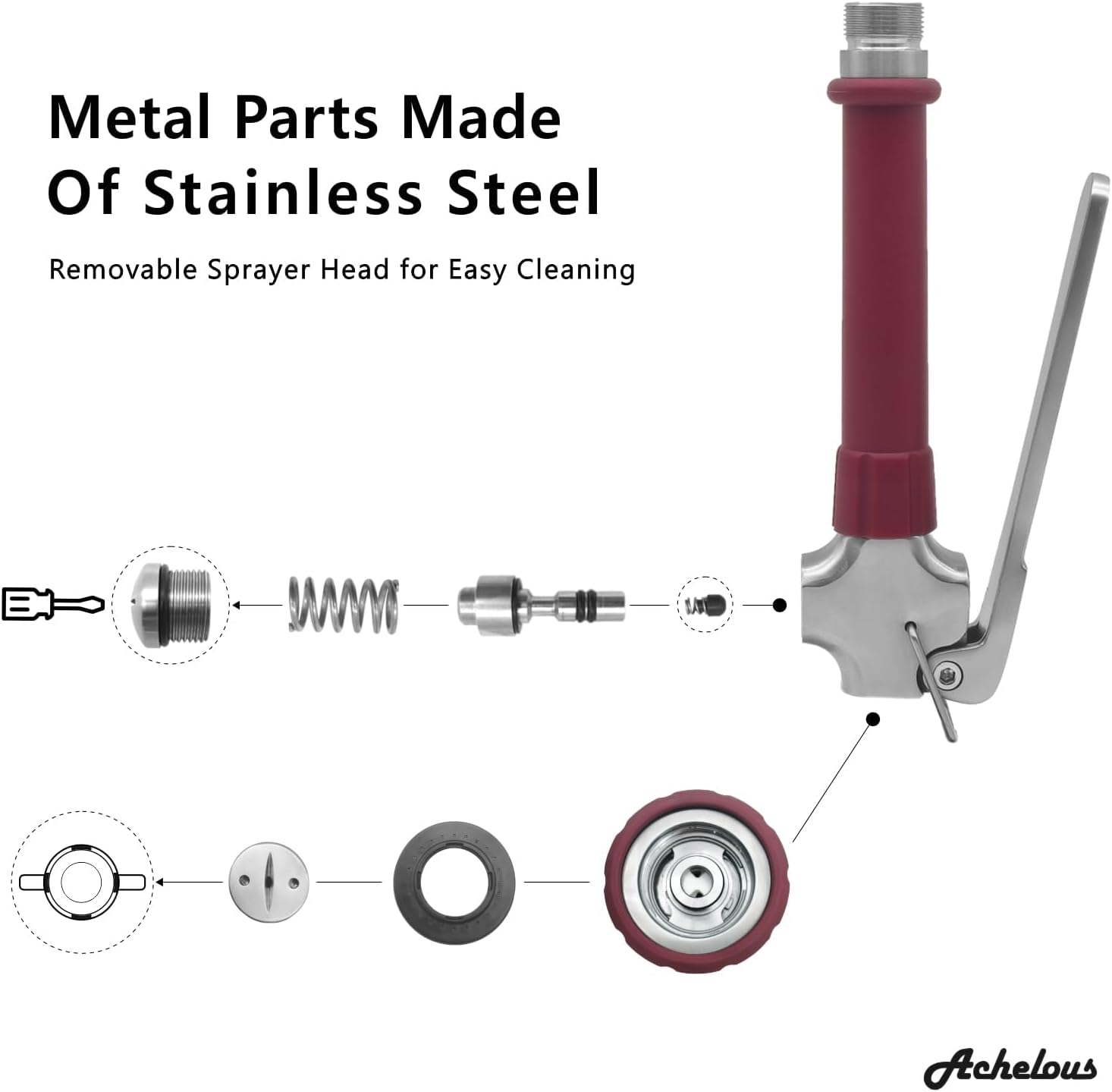
The 20-minute soak
- Close the supply stop under the sink.
- Unscrew the spray face. On most heads this is hand-tight only — no tools. If it won't budge, grip it with a cloth for purchase, not with pliers directly on the chrome.
- Drop it into white vinegar. Plain household white vinegar. Undiluted. You only need enough to cover the face.
- Wait 20 minutes. Resist the urge to scrub early — soaking does most of the work.
- Brush gently with a soft brush. An old toothbrush is ideal. Push a pin through any hole that's still blocked, working from the back so you don't deform it.
- Rinse it out and screw it back on. Hand-tight is enough. Don't crank it.
- Open the supply slowly and check for a clean, even fan.
Don't reach for anything stronger than vinegar. Harsh descalers can attack finishes and seals,
and they aren't necessary for calcium. If vinegar doesn't shift it after two rounds, move on rather
than escalating chemicals.
If the soak didn't work
Two rounds twenty minutes apart handles most cases. If it comes back clean and still sprays badly, you're dealing with one of these:
| Symptom after descaling | Likely cause | What to do |
|---|---|---|
| Weak everywhere, flow is fine | Scale further back in the hose or supply | Check the hose for kinks; descale the line |
| Drips when the handle is released | Worn cartridge or O-ring inside | Rebuild if it's a serviceable body — or compare the cost |
| Handle sticks, trigger loose | Worn internal mechanism | Same decision; usually the point where replacement wins |
| Hose cracked, kinked, or leaking | Hose is the most stressed part of the assembly | Replace the hose itself |
Stop doing this every month
Prevention is honestly just repetition.
- Once a month: pull the face and give it a five-minute vinegar bath during close-down. Waiting for symptoms means waiting until it's already slowing down service.
- Hard water areas: every two weeks. Ask around — your ice machine filter life tells you roughly where your water sits.
- Print this page and tape it up by the dish machine. Half the value is making sure the night crew doesn't bin a valve that needed twenty minutes in vinegar.
The expensive version of this mistake: commercial kitchens replace spray heads all the time
that were never broken. The unit goes in the bin, someone orders a new one, and the new one scales
up in exactly the same way in about the same number of weeks. Unless you change the maintenance, you
change nothing.
Still needs replacing?
If you've ruled out scale and the unit genuinely needs replacing, check the thread first so it arrives right the first time: read the fit guide. Then decide whether you want to rebuild or replace outright — that cost comparison is here.